
Writer: Meilia Irawan, S.Hum., M.Si. (Director of Peace and Conflict Studies, InMind Institute)
After a year of the Israel–Hamas conflict, the war is still raging and dispersed in several Arab countries, such as Lebanon and Iran. The prediction will continue to several other Arab regions and Gulf countries and potentially proliferate into a global conflict, also known as the Third World War.
The escalations are increasing after Iran was involved as one proxy and there were an unexpected and sudden attack. The conflict is heated after a series of reciprocal military engagements on June 13, 2025. The situation deteriorated as the hostility grew in scale and intensity after Israel hit Tehran’s nuclear program and struck Iran’s nuclear infrastructure. Conversely, Iran hit Tel Aviv and killed around 10 people in the beginning. Those are getting stronger because The U.S. is involved in the conflict and attacked three Iranian nuclear facilities in Fordow, Natanz, and Isfahan. In addition, Iran and Israel refuse to turn down the ceasefire. This conflict beneath the shadow of World War III (WWIII), on the condition when they refuse the negotiation and putting off the war. On the side, the U.S. and Europe (G7) sided with Israel; they are starkly adding the complexities of aggression if they join the conflict. The possibility of World War III can be exploded and totally has significantly impacted the Middle Eastern countries as regional conflict and spread as a global power battle.
The United Nations and the U.S. roles always drum for reconciliation between Israel and Arabs conflict, yet will not stop extending the hostilities. In this case, due to particular interest, reconciliation is an anecdote in the international peace forum. Even though the U.N. has stated that nuclear countries like Iran should stop spreading the conflict widely by using its nuclear, nevertheless, Iran asserted that the nuclear program is for peaceful purposes and national economic development—furthermore, Iran’s nuclear program under supervision by the International Atomic Energy Agency (IAEA). Meanwhile, it has a different stance from Israel, which does not admit its nuclear program publicly. This shows favoritism towards one side.
It is ‘a hard Nut to Crack’ to reveal the conflict in Iran-Israel nowadays; none other than want to go on. The ‘shadow’ under the third world war is possible can be ruining. The prediction of wars that exacerbate if America, NATO, Russia, and China join in a proxy war. Furthermore, it can extend to East Asia, between North and South Korea, China and Taiwan including Japan. The evidence of the Third World War is not easily predicted, but it could happened at any time. The situation is rapidly changing; it depends on the conflict related to geopolitics and nuclear issues particularly related to instability in Gulf countries. We can analyze from Iranian nuclear who have a long story conflict with Israel.
Iran’s Nuclear Program is frightening Israel and the U.S. as a significant reason why the escalation exists, rather than motivation to support people in Gaza or Hamas directly. However, Iran has been involved in the war with Israel since the 1980s and, directly in recent years, in the 2010s, joined a proxy war with Hezbollah and supported Palestine. Nevertheless, in every war, the economy is the main reason for the outbreak of war. Despite Iran’s being embargoed by America and European countries for almost 46 years, it has The Islamic Revolutionary Guard Corps (IRGC) as the guardian and military revolutionists with the top capacities and capabilities in all fields, including economic and enterprise business. That shows Iran is a powerful country in West Asia or between Arab regions.
The IRGC has a multilayer function in the economic, political, and ideology of the Republic of Islam Iran. They have positioned themselves in commercial and economic growth in Iran and have become giant economic enterprises. That is not relying on superpower countries’ weaponry and economic and Iran has political independence. Iran’s increasingly advanced and difficult-to-subdue condition is undoubtedly the main reason this war broke out. We can prove this with the threat of closing the Strait of Hormuz and the Iranian nuclear threat.
Third World War: Right Before Your Eyes
To convey the prediction, firstly, analysis of American military bases from a geographic landscape in the Middle East continent, such as the Gulf Cooperation Council: Bahrain, Qatar, Kuwait, United Arab Emirates, Saudi Arabia, Jordan, and Iraq is located in the Persian Gulf. According to https://www.cfr.org/, The U.S. military facilities are around nineteen sites, and eight are considered permanent to retain and respond to regional threats from Houthi as Yameni military organization, Hamas, and Iran – Israel tensions with 40.000 troops which are across the Middle Eastern countries.
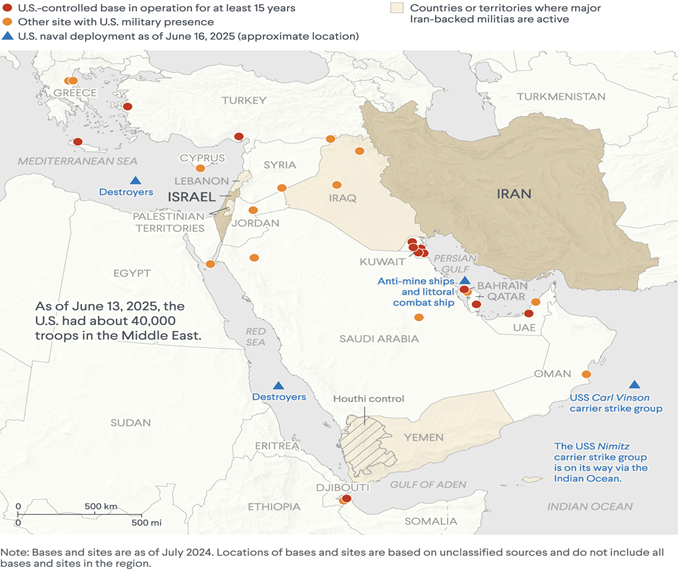
In this context, stability in the Gulf countries is essential because oil production contributes to world oil supplies through the Hormuz strait; if Gulf countries are involved and the Hormuz closes, that will be deteriorating or chaos because it is the world’s busiest, strategic location and most important waterway to contribute around 20 – 30% oil contribution to the world. If Iran threatened to close the Hormuz Strait, which is located between Iran and Oman, all countries would be oil deficient. According to the Commonwealth of Independent States (CIS), Europe consumes approximately 18.5 million barrels of oil per day, and Asia is represented by China, the largest consumer, which consumes 16.6 million barrels, meanwhile, India consumes 5.5 million. It has many consequences and costs.
On the other hand, when America joins the war and uses the U.S. military in the Middle East areas, it has multiple consequences. This means that Gulf countries will be involved in the war and that proprietary global proxy, West block and East block, possibly join and break WWIII; it spread quickly. WWIII depends on powerful countries such as Iran, Russia, and America to consider multiple consequences. The national interest of each country, like America, under President Trump’s decision, will be difficult and will require a lot of money. The estimated cost is around $10–20+ trillion, double the cost from World War II. Additionally, it will kill approximately a million people globally and have a high impact on national economic stability.
Therefore, my prediction of World War III is still unpredictable, but if we look at how President Trump responded to Iran’s attack on the US military in Qatar, World War III will not happen because superpowers such as Russia, America, and European countries are still not involved and are trying to prevent war through behind-the-scenes negotiations.
References:
Vishwanathan, A. (2016). Iranian nuclear agreement: Understanding the nonproliferation paradigm. Contemporary Review of the Middle East, 3(1), 3–22. https://doi.org/10.1177/2347798916632321
Hobbs, C., & Moran, M. (2012). Looking Beyond a Nuclear‑Armed Iran: Is Regional Proliferation Inevitable?. The International Spectator, 47(4), 127–148. https://doi.org/10.1080/03932729.2012.733206
Forozan, H., & Shahi, A. (2017). The military and the state in Iran: The economic rise of the Revolutionary Guards. Middle East Journal, 71(1), 67–86. https://doi.org/10.3751/71.1.14
https://hbcunews.com/2025/06/23/estimating-the-cost-of-a-hypothetical-world-war-iii/ access on July 26, 2025 at 16.00 WIB.
https://www.cfr.org/article/us-forces-middle-east-mapping-military-presence access on July 26, 2025 at 15.00 WIB.
Views: 143